
Biography of Paolo Agnoli
Paolo Agnoli: Essayist, Former Founder of Pangea Formazione
Paolo Agnoli (Rome, 1955) is an Italian essayist and science communicator whose work explores the complex intersections between science, history, and philosophy. His educational background forms a distinctive bridge between disciplines: having earned a Master’s degree (laurea under the pre-reform system) in Physics with honors—specializing in Nuclear Physics and winning the ‘Enrico Persico’ scholarship awarded by the Accademia Nazionale dei Lincei in his youth—and subsequently a Master’s degree in Philosophy with honors, focusing on the History of Scientific Thought. Over the course of his career, he translated this academic rigor into a successful management and entrepreneurial path, before dedicating himself to writing and public engagement.
Following his graduation in Philosophy, Paolo Agnoli collaborated for over two years with the Chair of the History of Medicine at Tor Vergata University of Rome. His work focused on critical analyses of data methodologies within medical sciences, contributing to the organization and delivery of academic seminars, where he also served as a lecturer.
After an initial period of research in nuclear physics applied to the medical field, he spent many years in executive R&D roles within major national companies in Italy. Early in his corporate career, he completed a full-time residential Master’s program in Computer Science at the Scuola Superiore Guglielmo Reiss Romoli in L’Aquila, an international center of excellence for ICT training within the former Stet Group.
During his tenure as an executive at Saritel and later Telecom Italia, Agnoli worked extensively in the United States in collaboration with Lucent Technologies—a global leader in telecommunications equipment that had absorbed Bell Labs. He also led R&D telecommunications projects across Chile, Argentina, Brazil, and Bolivia, working directly with national telecom operators in South America.
He went on to co-found (alongside physicist and friend Francesco Piccolo) Pangea Formazione, serving for years as its Director. Recognized as a national research institute by the Italian Ministry of Education, University and Research (MIUR), Pangea Formazione specialized in executive education and the development of Artificial Intelligence algorithms to support strategic business and industrial decision-making. Led by a team of physicists and mathematicians, the company was acquired in 2020 by Bain & Company, one of the world’s leading management consulting firms.
Paolo Agnoli has also collaborated with the Italian National Institute for Nuclear Physics (INFN) as a science writer and served as executive manager for Elecom-Lottomatica, a premier Roman wheelchair basketball team. Now retired from the corporate world, he devotes himself entirely to essay writing and public intellectual life (while enjoying road running and mountain hiking as personal passions). He authors articles, books, and analytical essays on historical and philosophical themes, driven by an ongoing intellectual curiosity regarding science, thought, and society.
He currently contributes to the cultural and current-affairs journals L’Undici and Immoderati, as well as the literary review journal Il Giornale Letterario. He is also active in the AI New Normal project, an initiative aimed at expanding public understanding of Artificial Intelligence.
In 2025, he was awarded the Nabokov International Literary Prize (Non-Fiction category) for his book Hiroshima e il nostro senso morale (Hiroshima and Our Moral Sense), an award held under the patronage of the Apulia Region, the Province of Lecce, and the Municipality of Novoli. An English edition of the essay, titled Hiroshima and Our Morality, was published in 2026. He was also awarded the PREMIO FRANZ KAFKA ITALIA® Immaginazione 2026 in recognition of his extensive cultural activities and contributions across various creative domains. The prize, named in honor of the Bohemian Jewish writer, is held under the patronage of the City of Udine.
Contact:

Gli Ebrei e la cultura
Perché ci sono così tanti nobel di origine ebraica
Albatros

Hiroshima e il nostro senso morale
Analisi di una decisione drammatica
Guerini Editore

Il senso della misura
La codifica della realtà tra filosofia, scienza ed esistenza umana
Armando Editore

Probabilità e scelte razionali
Un’introduzione alla scienza delle decisioni
Armando Editore

Why Did the Chicken Cross the Road?
Armando Editore
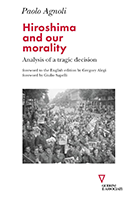
Hiroshima and our morality
Analysis of a tragic decision
Guerini Editore